
Celebrating with gratitude and honoring the balance of light and dark.
I grew up in the beauty of Northern Michigan, surrounded by the contrast of sparkling fresh water and rolling agricultural land. While each season had its own reason to show off, there was something exceptionally special about fall. The colors of maple trees turning so bright it looked as though their leaves could be flames. The pumpkin patches and apple orchards that line the county roads offering sweet cider and warm donuts that lure in children and adults alike. The cooler days that encourage you to cozy up with a blanket on the porch, favorite cup of coffee or tea in hand, and to just witness the moments of the year moving on. If you ask me, we're spoiled here in Michigan with idyllic "fall vibes".
I sometimes wonder if part of the reason fall is so treasured is because it feels like the first big pause of the year. After we came alive in spring and after we've embraced the long days of summer… and before the true rest of winter sets in… we find ourselves ready to slow down a bit, to regain a touch more balance in our lives, and to reflect on what is worth letting go of… no different than the trees do when it's time to let go of their leaves.
My hope with this post is to share with you the significance of this celebration, and the meaningful ways you can honor this time of balance, gratitude, and reflection in your own life.
What Is the Fall Equinox?
The Fall Equinox is the day when light and dark stand in perfect balance, typically landing around September 22–23 in the Northern Hemisphere (more on the astronomical mechanics of that below). It marks the second harvest of the season and a moment that asks us to reflect on the year's growth, express our gratitude in life, and yes… to start preparing for the coming winter.
This is, first and foremost, a solar event and one that ancient cultures were tracking and marking long before anyone organized it into a formal calendar. Agricultural communities across the world oriented their lives around these solar turning points out of necessity, not spiritual preference, watching the sun's path to know when to plant, when to harvest, and when to prepare for scarcity. They didn’t have the research and data we do today… but they had the sky and the seasons.
In more recent decades, this day has also become one of eight festivals on the modern Wiccan and Pagan Wheel of the Year. The Wheel of the Year is a framework built to honor all eight of the year's solar and seasonal turning points together… equinoxes, solstices, and the midpoints or “cross-quarter days” between them. The Wheel gives this day a home within a larger practice, but it didn't invent the occasion. It's one way of holding a celebration that's older and broader than any single tradition… because the equinox itself doesn't belong to any one tradition. It's a fact of the sky that every culture with eyes on the horizon eventually had to (and has to) reckon with.
Historically, the fall equinox falls as the second of three harvest festivals – arriving after Lughnasadh (or Lammas), the first grain harvest, and before Samhain, the final harvest and the doorway into the darker half of the year. For early farming communities, this stretch of the year wasn't just a big celebration for its own sake, it was about survival for them. At this time of year orchards were picked clean, root cellars were filling, and grain was being stored away before the first hard frost. They didn’t have the luxury of their gratitude being abstract or symbolic… it was tangible, practical and it determined how their winter (and lives) would go for the next few months.
The Fall Equinox or Mabon?
Like its counterpart at the height of summer, this celebration goes by different names, each carrying a different lineage.
The Fall Equinox (or Autumn Equinox) is the astronomical term for the precise moment the sun crosses the celestial equator and day and night settle into perfect balance, just before the nights begin to outpace the days. Since it belongs to no single tradition, this makes it the most universal way to talk about this day (and my personal choice).
Mabon is the name most associated with modern Wiccan and Pagan practice today. Like other sabbats in The Wheel of the Year, it wasn't handed down from ancient sources. It was given to this holiday in the 1970s by Wiccan author Aidan Kelly, who borrowed the name from a figure in Welsh mythology. It's a fairly recent name for a very old celebration, but however you refer to this day, it's pointing to the same moment: the year settling into balance right before the dark half begins.
The Fall Equinox in the Sky
Astronomically, the Fall Equinox marks the moment the sun crosses the celestial equator heading south, giving the Northern Hemisphere close to equal hours of light and dark before the nights take the lead for the next six months. This is the official start of the fall season.
Astrologically, this equinox opens Libra season, ruled by Venus, the planet of beauty, connection, and harmony. Libra is a cardinal air sign, and its arrival right at the equinox is no coincidence as the sign most associated with balance takes the stage exactly when the sky itself is in balance. After weeks spent in Virgo's detail-oriented, task-driven current, Libra invites something softer: relationship, fairness, beauty and the practice of weighing things evenly instead of rushing toward a conclusion.
The Fall Equinox sits directly opposite the Spring Equinox (Ostara) on the Wheel of the Year, and the two are worth holding in mind together. Where Ostara marks the tipping point into growth and light, the Fall Equinox marks the tipping point into rest and dark. One is the inhale and the other the exhale. Both days hold the exact same balance of light and dark, but they're moving in opposite directions. For my friends in the Southern Hemisphere, Ostara is their celebration this time of year.
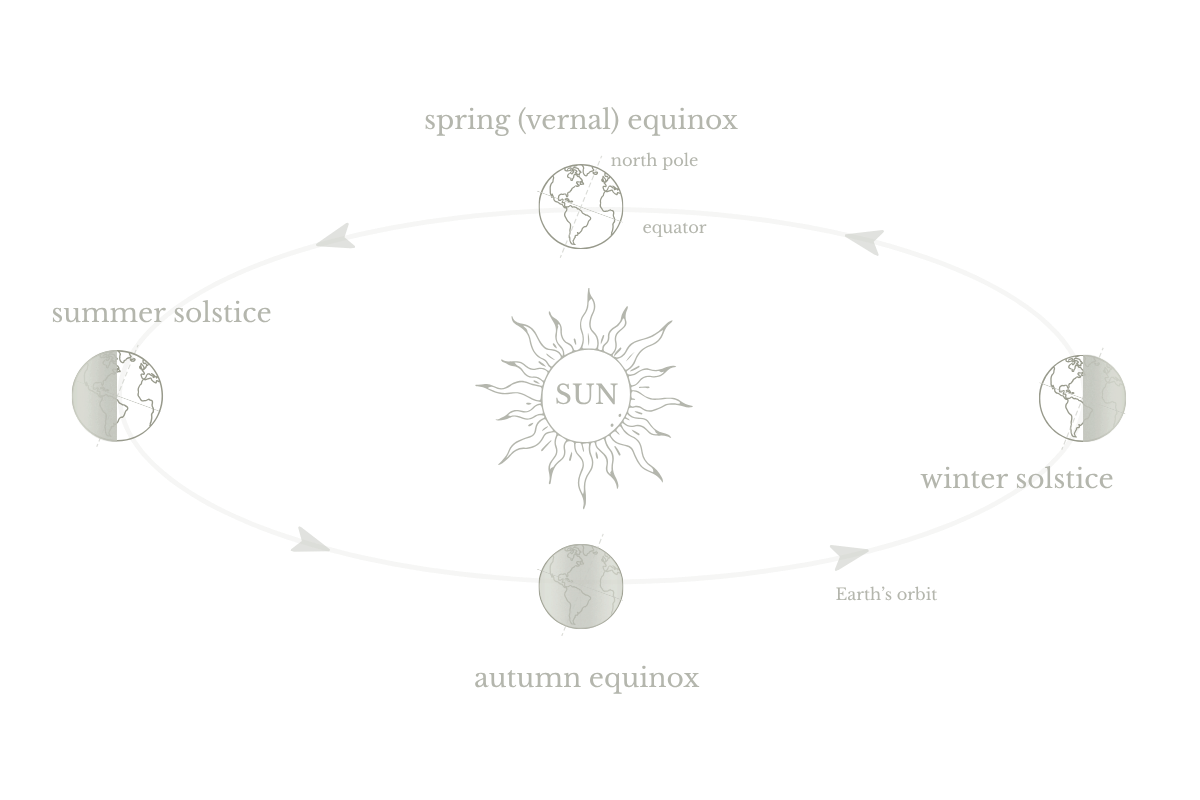
An astronomical snapshot I made of Earth’s placement in relation to the sun on the solstices & equinoxes.
The Fall Equinox in Story and Symbol
Like all the seasonal celebrations and transitions of the year, the Fall Equinox carries its meaning through myth with stories that speak to the land and to the inner turning each of us moves through too.
The Descent of Persephone
In Greek mythology, this is the season when Persephone returns to the underworld to be with Hades, bound there in part by the pomegranate seeds she once ate. Her mother, Demeter, goddess of the harvest, grieves so deeply in her daughter's absence that the earth cools and goes dormant. It's a story less about loss than about rhythm, and proof that withdrawal and darkness aren't punishments, but part of a cycle that always finds its way back to spring.
The Harvest Lord
Older British folk tradition tells of a grain spirit (sometimes called John Barleycorn… catchy) who is cut down at harvest, threshed, and transformed into bread and ale. It's a story of sacrifice in service of continuation: the plant gives itself so the community can eat and drink through the months ahead.
The Weighing of the Light
Because the equinox is one of two days when light and dark are perfectly matched (the other being the Spring Equinox (Osara), many traditions treat it as a threshold. It’s a day for weighing what's grown and being gathered against what's dying and ready to be released. It's often considered the quiet opening act to the more famous thinning of the veil at Samhain: a first loosening of the boundary between what is known and what is hidden.
Across these stories, the same idea keeps surfacing: balance isn't a truly static state, it's a hinge point. The Fall Equinox encourages us to stand on that hinge for a moment… to feel the sway between… fully aware of both what we're carrying and what we're ready to set down.
Symbols and Seasonal Traditions
One of the simplest things to do when it comes to recognizing these seasonal celebrations is to take note of the symbols associated with them. With our fast-paced modern world, having an idea of these various associations allows us to create our own symbolic relationship with the day.
Colors: Deep orange, burgundy, plum, and gold echo the turning leaves. Muted browns and amber speak to the earth itself and to the harvest coming in.
Flowers and Foliage: Chrysanthemums, marigolds, and sunflowers gone to seed. Dried wheat, dried grasses, and oak or maple leaves at the peak of their turning.
Harvest Symbols: Apples, pumpkins, squash, gourds, and corn… these are truly the visual for this entire season. A cornucopia, overflowing with whatever the season has to offer, is perhaps one of the oldest images tied to this day.
The Scales: A pair of balanced scales is the quiet symbol of this equinox, standing in for the exact measure of light and dark this one day holds (and a nod to the glyph associated with Libra).
Cider and Harvest Foods: Apple cider, spiced baked goods, root vegetables, and anything roasted low and slow. Think of foods that taste like a season's work finally paying off.
Nuts and Seeds: Acorns, walnuts, and seeds set aside for the months ahead… these small, quiet symbols of provision and preparation. Watch a squirrel this time of year… their foraging is impressive.
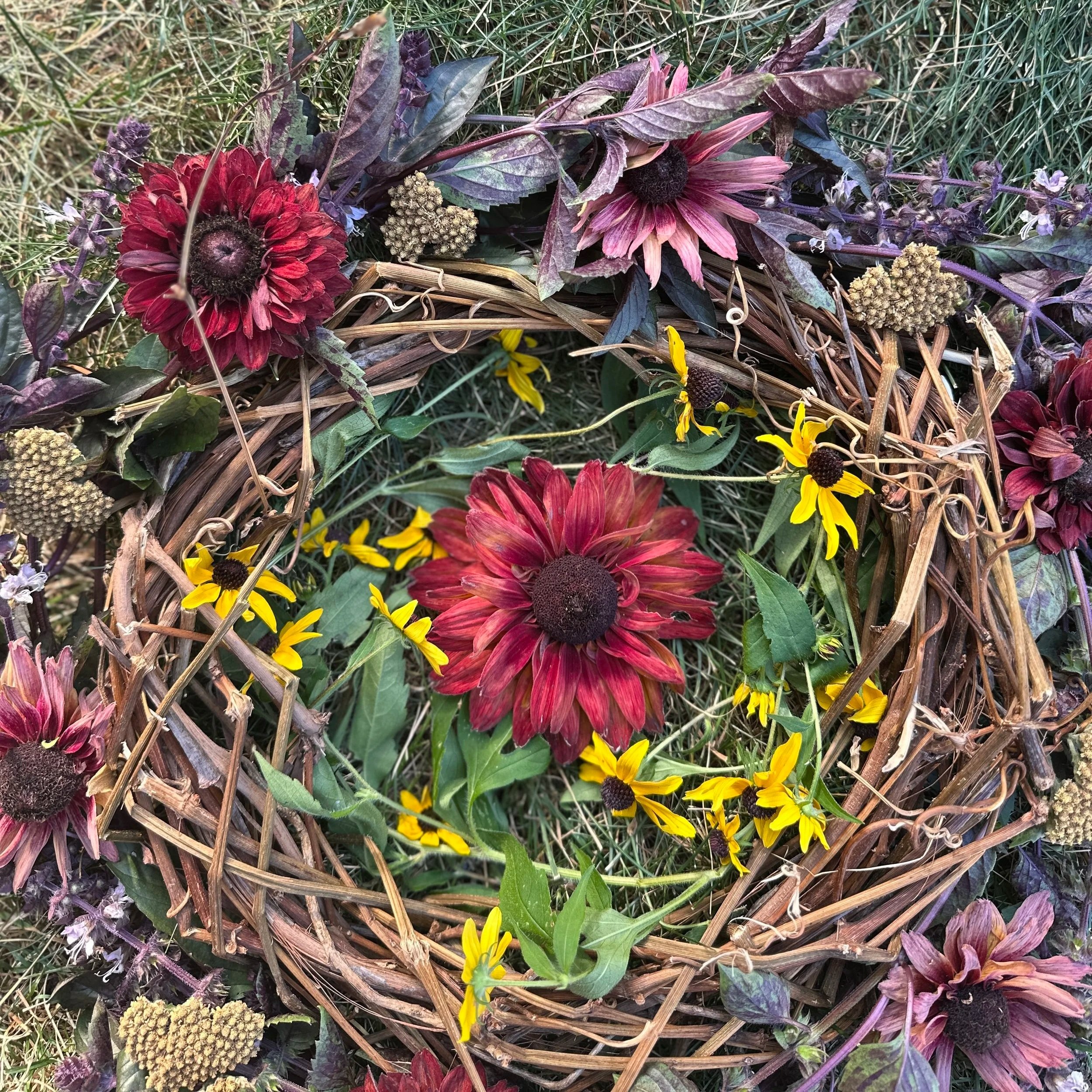
A small yard altar I made honoring the transition from summer to fall.
Simple Ways to Celebrate
You don't need elaborate rituals to honor the Fall Equinox. What this day asks for most is a willingness to actually pause in the balance rather than rush past it on the way to autumn's busier holidays or Instagram-friendly photo shoots (although I think we’re all probably guilty of that because after all, it IS such a charming and picturesque time of year)...
Watch the Sunrise or Sunset: On one of only two days of the year when light and dark are perfectly matched, take a moment to watch the sky do its work.
Build a Harvest Altar: Gather apples, pumpkins, dried leaves, or acorns from your own garden or a local farm stand (or grocery store if that’s easiest). Add candles in deep autumn tones and let the altar hold space for your reflections through the season.
Take a Gratitude Walk: Go outside and collect what the season is offering to you such as colorful leaves, acorns, twigs or pinecones. Notice the cooler air, the smell of fallen apples, the crunch underfoot. (Now, do this responsibly of course and in spaces where you have permission to do so).
Host an Autumn Feast: Cook with what's ripe right now, like apples, squash, root vegetables, and warm spices. The smell of fresh apples and cinnamon stewing on the stovetop is an immediate (and easy) way to celebrate the season. Have some friends over, share it with people you love and say out loud what you're grateful for.
Make Something by Hand: Weave a wreath from dried grapevine, press leaves, or put together a seasonal centerpiece. Let your hands slow down and along with the season.
Journal on Balance: Write about where your life feels weighted right now. Where is there too much output and not enough rest… or the reverse? Ask yourself what needs to shift so you land closer to somewhere in the middle.
Practice a Release Ritual: Name something you're ready to let go of as the year moves toward its darker half. This could be a habit, an expectation, a project that's run its course, and mark that release with a small gesture, like writing it down and setting the paper aside. Or, my favorite, carefully burning it outdoors and watching the smoke be carried away on the wind.
Embracing the Season
The Fall Equinox is an invitation to stand right in the middle… not fully in the light and not fully in the dark… but held for one day in equal measure of both. There's something worth honoring in that in-between place, even when our instinct is to rush toward one side or the other… especially in our modern world. We think of what’s next, how to do more, move on, keep going… and all of that is true. But this day let yourself pause a minute. Settle into the space between (cue up this Dave Matthew’s Band song if you need to) and let that space be a bit more familiar to you.
This day is also a reminder that balance isn't something we arrive at once and keep forever. Balance isn’t a set point. Like the equinox itself, it's a point we pass through on the way somewhere else. The work isn't to hold the middle permanently (that’s impossible)... but rather to notice when we're standing in it, and to give that moment the attention it deserves before the year tips toward its next season.
So this equinox, I hope you find a way to pause in that balance, even if briefly. To gather something from the harvest of your own life, to light a candle as the evening comes earlier, and take stock of what this year has grown in you so far.
The scales are level, if only for a moment, and we're invited to stand in the middle of them… let yourself do so.

Maple leaves - in my opinion - offer the best fall color display.