
Gardening with the Moon
Moon phases, zodiac signs, and how to use them in your garden.
The first time I heard about gardening by the moon, I was immediately, completely sold.
As someone who already works with the moon and the zodiac for almost every other part of my life, learning that it connected to the farm… to the actual soil, the seeds, the timing of a harvest… felt like a synchronistic click. Like the last piece of something snapping into place. It's honestly a thread that bridges all of my work together: the astrology, the farming, the recognition of the cycles and ourselves within them. They're not separate things. They never were.
So naturally, I did what I always do: I went all in. I bought the books, ordered the calendars, and mapped everything out on massive paper sheets. I dove in head first (true to form) and suddenly realized that while the language of biodynamic planting made sense, the reality of following through in my actual first year as a flower farmer was going to be a bit more challenging.
So I did what I could, and when it synced up, it was a bonus… but I didn't hold myself to every detail.
Now, four years into it (and with a bit more understanding of what I'm doing) I've figured out what works for my routine and what doesn't… and that's what I want to share here.
What Biodynamic Gardening Actually Is
Biodynamic gardening grew out of a series of lectures by Rudolf Steiner in the 1920s, but the practice as most of us know it today owes just as much (if not more) to Maria Thun. Thun spent decades in the field (literally) testing Steiner's theories through rigorous trial and observation. She's the one who mapped the relationship between the moon's movement through the zodiac and plant growth, developed the four plant-part categories (root, leaf, flower, fruit), and created the biodynamic sowing calendar that practitioners still use today. Steiner gave the philosophy. Thun gave it roots.
The premise of the theory and practice is that the earth is a living system and that cosmic rhythms (the moon's phases, its movement through the zodiac) subtly influence how energy moves through plants. Roots, leaves, flowers, and fruits all respond differently depending on what's happening in the sky.
A quick honesty note: biodynamic gardening is a rich, layered practice that goes well beyond what I'm sharing here. There are soil preparations, composting techniques, and planting calendars that go much deeper than I personally work with. I'm not a biodynamic purist… I'm a flower farmer and an astrologer, and the part that lit me up was the moon and the zodiac. That's the language I already spoke. So that's what I've taken into my own practice, and what I'm passing along here.
You don't have to believe any of this completely to find it useful. I'd invite you to simply try it and see what you notice.
Working with the Moon's Phases
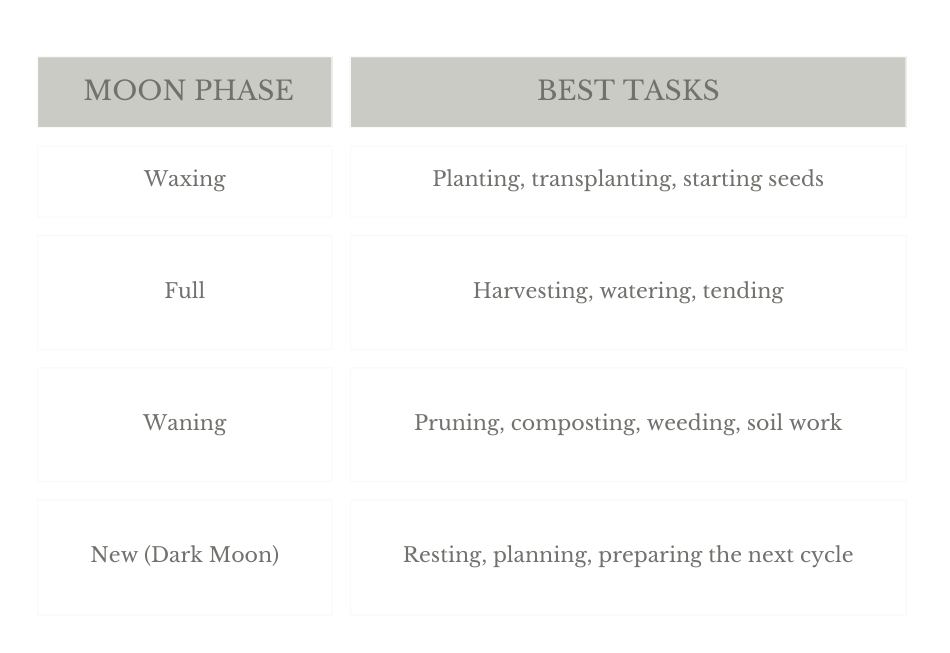
The moon cycles through four phases roughly every 29 days, and each phase creates a different quality of energy for your garden.
New Moon → Waxing Moon: As light builds, so does upward energy. This is the time to plant crops that grow above ground such as leafy greens, beans, and flowers. It's a natural moment for beginnings: sowing seeds, starting new beds, setting intentions for the season.
Full Moon: Energy peaks. Moisture rises in the soil and in plant tissue. The full moon is ideal for harvesting (especially herbs and flowers meant for drying), deep watering, and anything requiring vitality. It's also a beautiful time to simply be in the garden and to notice what's thriving…(full moon rituals, anyone?)
Waning Moon → Dark Moon: Energy moves downward and inward. This phase supports root crops like carrots, beets, potatoes and of course bulbs or tubers. It's also the right time for pruning, composting, weeding, and soil work. Think of it as the garden's exhale and a clearing that makes space for what comes next.
A simple way to remember: waxing for above-ground, waning for below-ground.
If working with the moon phases already feels like enough… it is. Many gardeners work exclusively with the four phases and never layer in the zodiac signs at all. That's a complete practice on its own. But if you're astrologically inclined, or just curious to go further, the zodiac adds another layer of nuance (because each zodiac sign is connected to an element which is connected to a part of the plant… more on that below). Think of it like this: the moon phase tells you the quality of energy; the zodiac sign tells you where to direct it.
The Four Elements and What They Mean for Your Plants
As the moon moves through the zodiac - spending about 2–3 days in each sign - it activates one of the four classical elements. Each element corresponds to a part of the plant and a type of garden task.
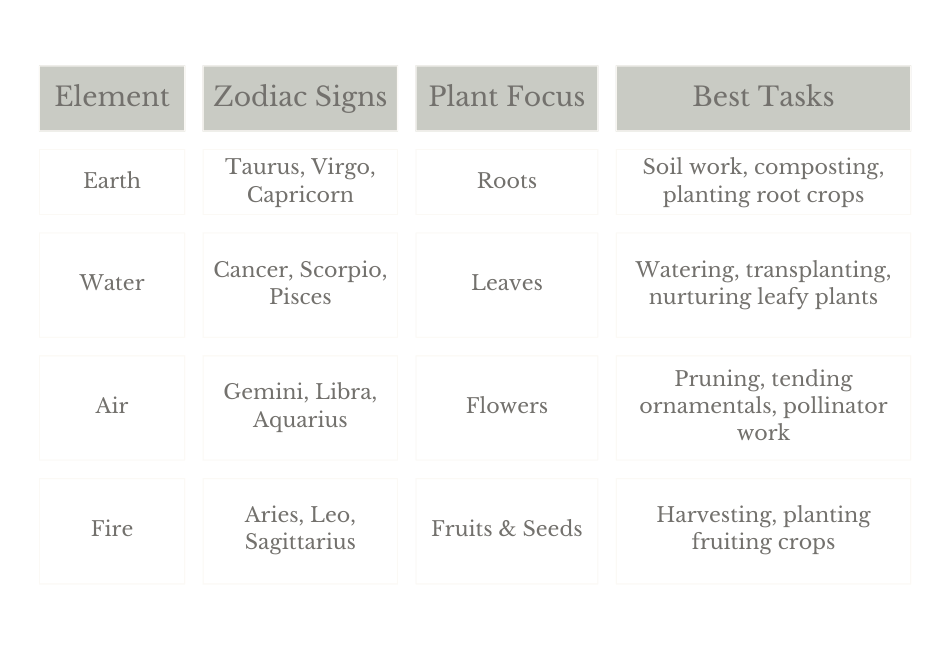
So if the moon is in Taurus (Earth), it's a root day and good for digging, amending soil, or planting garlic. If it's in Libra (Air), it's a flower day and great for cutting arrangements or tending your perennial beds.
You can track the moon's sign in any astrology app (I love this one from Astro-Seek) or a printed biodynamic calendar (I highly recommend the current year almanac that follows Maria Thin’s practice) . Over time, you start to feel the difference as certain days in the garden just move better than others.
Putting It Together: Three Examples
Let’s venture back to our classroom days and work on some examples to understand the basics.
Waxing Moon in Cancer (Water): A gentle, nurturing window. The moon is gaining (ascending) in a water sign. Plant your leafy greens or transplant seedlings. Water deeply. It's also one of the best times for anything that needs coaxing like tender plants, new cuttings, or anything still finding its roots.
Full Moon in Leo (Fire): Peak energy, fire sign. The moon is as bright as it will get and in a fire sign. This is a harvest day and especially beautiful for cutting flowers at their most vivid. If you grow dahlias or sunflowers, a full moon in Leo is a gift.
Waning Moon in Virgo (Earth): Earthy, methodical energy. The moon is losing (descending) in an earth sign. Turn the compost, pull weeds, amend beds. A good day for the quieter, less glamorous work that makes everything else possible.
A Quick-Reference Guide & Visual (for the Moon Phases only)
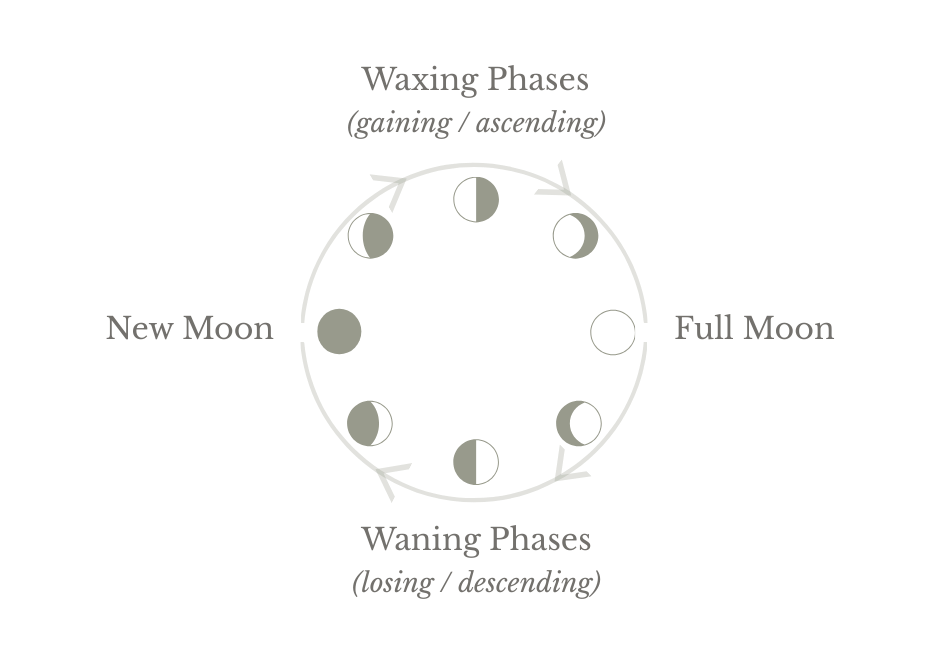
For the visual people (like myself) here’s another example. From the New Moon to the Full Moon, the energy is Waxing. From the Full Moon to the New Moon, the energy is Waning.
How to Start (Without Overcomplicating It)
You don't need to do this perfectly… trust me. I'd actually encourage you to resist the urge to optimize it.
Start with one thing: check the moon phase before you do your next big garden task. Notice how the plants respond. Keep a small garden journal with even just a sentence or two to help you keep track of things. "Waning Moon in Taurus. Worked the soil. Felt settled." or “Waxing Moon in Gemini. Started seeds. Felt inspired.”
When that starts to feel natural, you can add the zodiac layer if you're curious. Or not. Both are valid. The point isn't to follow a system necessarily, it's to start paying attention in a new way.
Over a season, you’ll notice patterns emerge. Not because you figured out the rules, but because you started to listen. That's the whole invitation of biodynamic gardening, really… not a new set of demands, but a different kind of relationship. One where you're not managing the garden so much as learning to move with it. And doesn’t that sound like the ideal when it comes to growing?
Ready to Grow with Intention?
If this post resonated and you want to take your garden a step further this season, Rooted in Magic is for you. This is a practical guide to growing flowers with elemental intention - including plant guides and suggestions, information to help you plant with the moon, and simple layouts to get you started.
Turn your garden into something even more magical this season.
